Data
Flicka engines
A variety of small diesels have been fitted to the Flicka 20 — the most common, by far, is the Yanmar 1GM10. Single cylinder, raw-water cooled, and famously durable. Below: notes on the 1GM10 and the modern alternatives that have come up since.
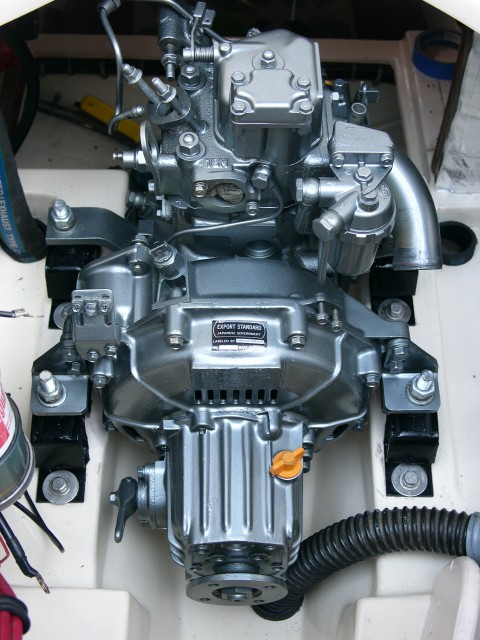
The standard engine: Yanmar 1GM10
The Yanmar 1GM10 was the chosen engine for the Pacific Seacraft Flickas, and the original engines are still running in many of these boats. It is not unusual to see a 1GM with 4,000–6,000 hours on it that has only ever needed routine service.
Yanmar has a huge global network, and parts are readily available in most ports. The 1GM10 is mechanically simple and can be repaired and maintained by most reasonable mechanics, anywhere in the world.
It has been around since the late 1970s and is still available almost unchanged in design. The 1GM was modified slightly and became the 1GM10 in the mid-1980s. Recently the engine has met serious competition from smoother and quieter two-cylinder engines of similar size.
Yanmar 1GM10 technical specifications (PDF) →
Advantages of the 1GM10
- The lightest and most compact marine inboard engine of its class.
- Proven reliability. Simple, tough, and — properly maintained with clean fuel and water — almost unbreakable.
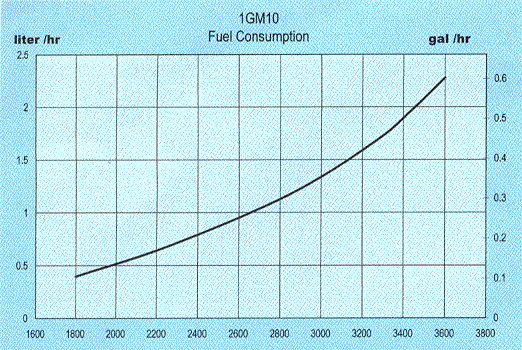
- Cheap to maintain and run. About 1 litre per hour at 2,600 RPM, rising to 1¾ litres at 3,000 RPM.
- Spares are everywhere. Yanmar's network is worldwide.
- If something does go wrong, there is nearly always a Yanmar specialist nearby — and any reasonable mechanic will understand it.
- Raw-water cooling is simpler: one water pump, no heat exchanger, no header tank, no antifreeze.
Disadvantages
- Engine oil and filter every 100 hours can mean twice in a season for Mediterranean cruisers.
- Replacing the oil filter is a horrid job — the filter sits horizontally and is impossible to remove without spillage.
- Replacing the gearbox oil requires a pump; there is no sump nut.
- The seals on the raw-water pump fail regularly and the pump needs an overhaul most seasons in salt water.
- The engine anode is awkward to replace — usually means removing either the starter motor or the alternator first.
- The exhaust elbow corrodes and requires regular inspection.
- Engine mounts (£70 each from Yanmar) lose their paint within weeks and rust quickly.
- The primary fuel filter has delicate threads on the bleed-screw housing that wear out over time.
- Yanmar parts are high-quality, but priced accordingly.
- The engine is loud, and the single cylinder transmits a lot of vibration.
- Exhaust emissions don't meet current guidelines.
- Raw-water cooling means the engine itself is more prone to internal corrosion than a fresh-water-cooled equivalent.
- The hand-start handle is a curiosity rather than a usable feature — it's on the camshaft end and spins anticlockwise.
Tips for 1GM owners
- Use the small spanners that ship with the engine — they fit awkward places nothing else does.
- Keep the engine clean and free of salt water at all times.
- Check shaft alignment every season. Fit an Aquadrive and sound-proofing if you want a different boat.
- Clean the raw-water strainer regularly.
- Fit a fuel/water separator from a quality brand (Racor or equivalent).
- Fit a small inline fuel filter near the tank.
- Clean the fuel tank every few seasons.
- Fit an auxiliary fuel pump.
- Make sure the temperature sensor and alarm system are working before every passage.
- Do your own routine maintenance — you'll know the engine, and small problems get caught early.
- Look after the batteries and starter motor.
The modern alternatives
After decades of 1GM monoculture, two-cylinder engines now exist in the same physical envelope and weight class. They are noticeably smoother and quieter. The three options Flicka owners look at most often:
Nanni 2.10
Nanni markets the 2.10 as a direct replacement for the 1GM10 — same physical envelope, same mounting, similar weight. It is a Kubota-based two-cylinder, smoother and quieter than the Yanmar, and increasingly common in retrofits.
Nanni 2.10 specifications (PDF) →
Beta 10 and Beta 14
Beta's 10 hp and 14 hp engines, like the Nanni, are Kubota-based but assembled in the UK. Beta will supply with a Balmar high-output alternator from the factory, which is useful for cruisers. The 14 hp gives more reserve in chop and a heavier dinghy in tow. Both fit the Flicka engine bay with minor adapter work on the mounts.
Beta 10 specifications (PDF) → · Beta 14 specifications (PDF) → · Beta UK · Beta US
Vetus M2.C5 / M2.D5
The Vetus two-cylinder M-series engines are also worth a look. Smoother than the 1GM, with Vetus's reputation for tidy installations and good support throughout Europe.
Why an owner might consider not buying Yanmar
- Service issues experienced under warranty, reported by some owners.
- Yanmar parts are increasingly (and, owners say, unreasonably) expensive.
- Several quieter, smoother, more environmentally friendly engines now exist in the same envelope.
- The 1GM10 has no comforts at all for a small-boat owner — no fresh-water cooling, no second cylinder.
- The raw-water pump is a constant maintenance headache.
- The mounts will probably rust in their first season.
None of which is a reason not to buy a Flicka with a 1GM still in her — the engine is reliable, simple, and will run for decades. But if you are repowering, the alternatives deserve a serious look.