Data
The Flicka rig
Three rigs have been fitted to the Flicka 20 over the years — the production Bermudian sloop, the original Bingham gaff cutter, and the junk variants. Sail plans for each below.
Bermudian sloop
The standard rig fitted to almost every Pacific Seacraft Flicka. A masthead sloop with a fractional roller jib and an aluminium spar — easy to handle, well-balanced, and forgiving.
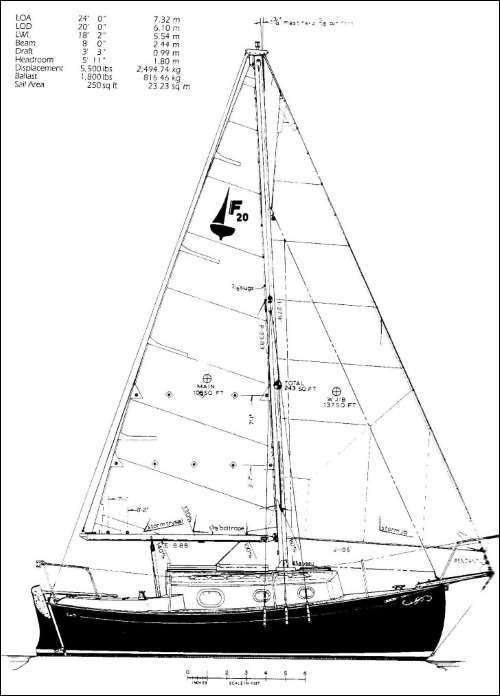
Mast and boom are aluminium painted with twin-pack polyurethane. Standing rigging is 1×19 stainless wire, with a single set of upper and lower shrouds either side. The forestay terminates at the stemhead bowsprit fitting and is normally fitted with a roller-furling drum.
Sail area is hardly larger than a dinghy's, but with 5,500 lb of displacement the boat carries it well. Reefing is single-line and deep — owners typically tuck the first reef in around 18 knots and the second by the time it's blowing 25.
Gaff cutter
Bruce Bingham's traditional gaff-rigged variant — the rig Bingham himself drew in the original plans before Pacific Seacraft simplified to a Bermudian for production. Beautiful, period-correct, and slightly more sail area to weight than the standard sloop.
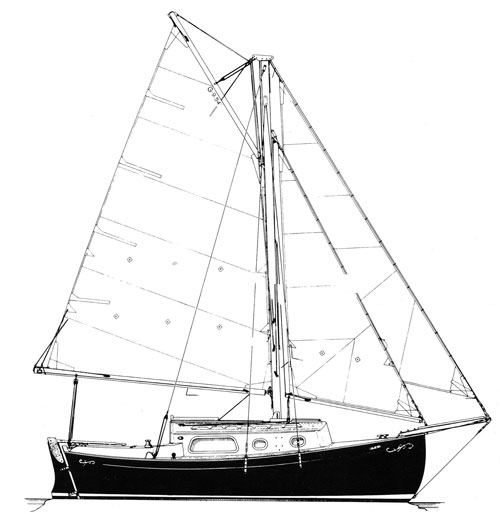
Most gaff-rigged Flickas were home-built from the original Bingham plans. The cutter staysail and short bowsprit are a meaningful upgrade for off-wind work, and the lower aspect ratio of the main copes well in heavy weather.
s/v SYNTHESIS, pictured below, was a gaff-cutter Flicka that completed a 200-mile passage in the Bahamas in 1994 — the kind of voyaging the rig was drawn for.

Junk rig
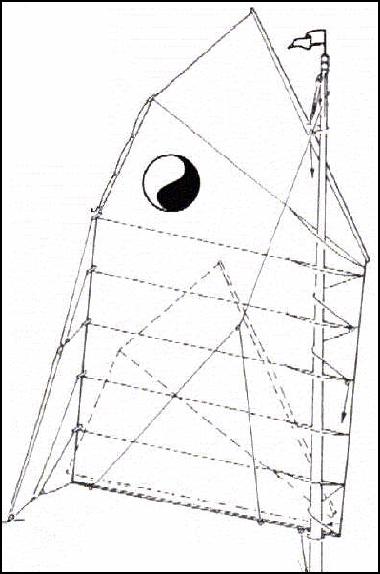
A handful of Flicka 20s have been converted to junk rig — single-handed-friendly, easily reefed, and cheap to maintain. Perry Phillips drew up the plans below; the resolution is poor (these are scans of decades-old originals) but the proportions are clearly there.
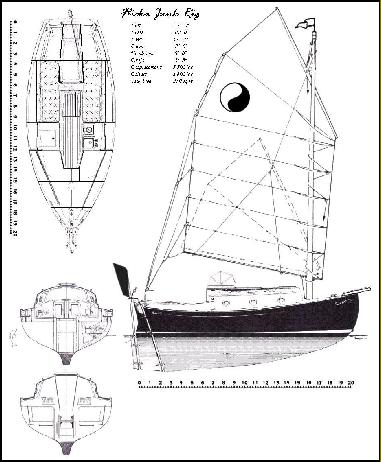
The junk rig keeps all sail-handling lines back to the cockpit, has no stays to maintain or replace, and reefs by simply easing the halyard. For a single-hander cruising long distances, the trade-off — slightly less to-windward performance for a much simpler, more durable rig — is one many Flicka owners have found worth making.