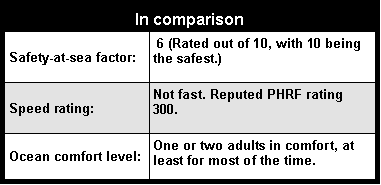
Review
"What's the Flicka got that makes otherwise rational deep sea sailors haul out their checkbooks?"
by John Vigor, originally for Good Old Boat. Re-published here with the magazine's permission.
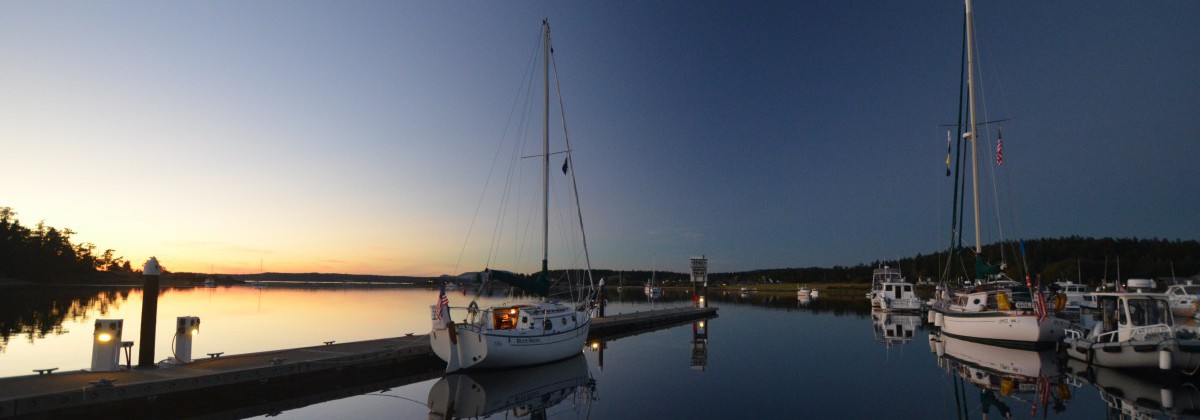
You can't hold a sensible discussion about small seagoing sailboats without mentioning the Flicka 20. Who, you might ask, would willingly pay $60,000 to $70,000 to go to sea on a boat only 20 feet long?
The answer to that question is hundreds of people. At least 400 so far. So the next question is: Why? What's this snub-nosed midget got that makes otherwise rational deep sea sailors haul out their checkbooks?
She is also, in many ways, a dream boat. She appeals to the adventurous spirit that erupts in all of us from time to time, even the armchair sailors. She's capable of crossing oceans in safety. She's small enough that her berthing fees are minimal. She's extraordinarily well built. She points to a heritage of working sailboats that goes back well over a century, and yet there is no boat quite like her in production today.
There is also a good deal of reassurance in the fact that the designer of this boat, Bruce Bingham, lived and sailed on her for two years. He and Katy Burke cruised 6,000 miles in a Flicka called Sabrina, and the boat clearly has the imprint of two people who actually used what they drew.
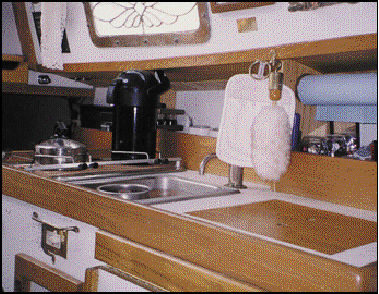
The art of yacht design lies in intelligent compromise, and if you want to create a lot of space on a short waterline, you have to sacrifice looks or performance — or a bit of both. Bingham took a small hit in both directions: the Flicka has a deep, plumb bow and a tubby afterbody. She is, as some kind soul once said, "cute."
And in this case, cute on deck translates into palatial accommodations down below, including headroom of 5 feet 11 inches and three full-sized berths. She's a heavy-displacement, Bermudian-rigged sloop with a long full keel and a massive amount of ballast for her size — about 1,800 pounds of internal lead encapsulated in fiberglass.
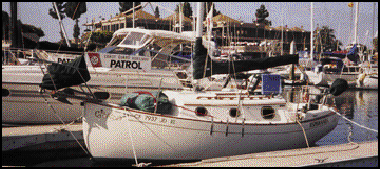
Her bow, like that of the Dana 24, is distinctively plumb. Each Flicka has a fancy curlicue molded into each side of the bow, joined by a cove line to a smaller one at the stern. She sports a graceful sheer and a generous, springy bowsprit.
The Flicka is well endowed with beam — 8 feet (the same as a Cape Dory 25D) on a waterline of only 18 feet 2 inches. That slows her progress through the water but gives her spacious accommodations and the form stability that, with the deep keel, lets her stand up to her sail in a breeze.
The decks are surrounded by raised bulwarks with a heavy teak caprail — the true sign of a bluewater voyager. The side decks are fairly narrow, but the working space at the foot of the mast is adequate.
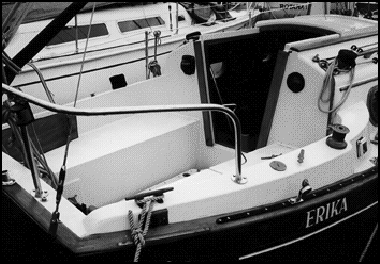
The self-draining cockpit is small, but adequate for two, and is uncluttered by the mainsheet, whose traveler attaches to the pulpit railing aft. A watertight hatch in the cockpit sole affords excellent access to the engine.
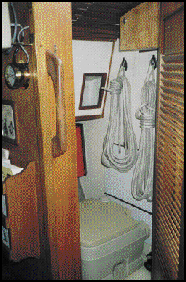
The Flicka carries 20 gallons of fresh water in a tank under the quarterberth. The head holding tank has a capacity of 8 gallons, and the diesel fuel tank, which lives up forward under the V-berth, holds 12.
The standard inboard engine is the ubiquitous Yanmar 1GM10, a single-cylinder diesel of 9 horsepower fitted with a 35-amp alternator. It's a good match for this boat and very economical.
Accommodations
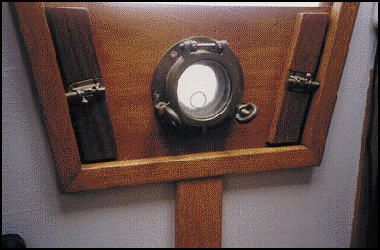
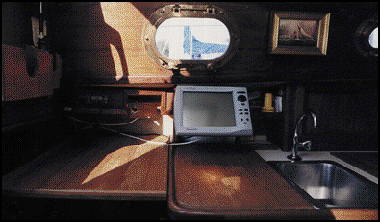
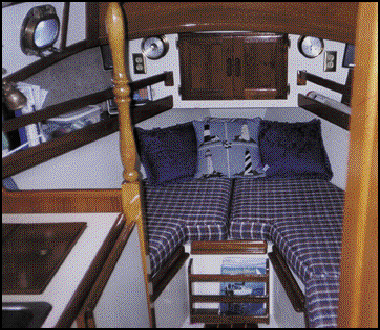
As you step below on the Flicka, you gain the reward for her "cute" exterior. The interior is absolutely huge for a 20-footer, warm, and inviting. The portlights are of solid bronze, and all six open. The light is good and the ventilation excellent.
The rig
With spars and sails hardly bigger than a dinghy's, there's nothing complicated about this rig. Both mast and boom are made of aluminium, painted with twin-pack polyurethane paint. The mainsail has an area of about 110 square feet and the working jib about 75. The boom is short enough that an experienced sailor can fit a small bimini under it without catching the sheet on every tack.
Performance
"Long passages of a 5-knot average and better are not uncommon," says the Pacific Seacraft brochure. Well, you can't ask for much better than that. And if you count interior space and comfort as a measure of cruising performance, then the Flicka is in a class very much of her own.
Known weaknesses
- Smallness. Size is not the major factor in seaworthiness, and a small boat used with common sense and great caution can be reasonably safe at sea — but smallness has its own costs in motion comfort and stowage.
- The difficulty of carrying a shore tender. Even a rolled-up inflatable takes up a lot of room below on a boat this size.
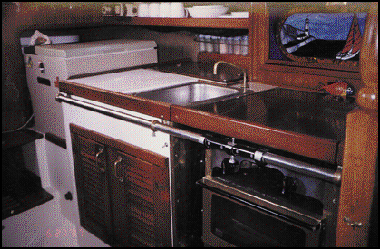
- The stove is not gimbaled.

"On the way back I took a swing through the massive anchorage, counting 27 cruising boats of all designs, sizes, and flags …" wrote one cruiser. "Kawabunga was by far the smallest, and by my eye, the most charming craft."
Owner's opinion

One of the most famous owners of a Flicka is John Welch, who is retired and lives in Hawaii. He has sailed Betty Jane from California to Hawaii, and from Hawaii to Tahiti and back.
Tom Messick is also the famous owner of a Flicka, but he's famous for a different reason. He and his teenage daughter Mitzi went aground in their boat, Tondelayo, during a lightning storm in Tampa Bay. The boat sat on a rocky bottom for hours, taking a pounding that — by Tom's later reckoning — would have ended a lighter boat. Tondelayo was refloated, repaired, and continued cruising.
"I have to conclude that our Flicka is one very tough lady."
Conclusion
The Flicka is high quality in a small package with a large price tag. Because she is a cult boat, and because she is strongly and sensibly constructed, the Flicka retains her value very well on the secondhand market. She is a serious bluewater boat in miniature and not the cheapest way to go cruising — but for the sailor who wants the smallest boat that is still a proper ship, the Flicka is hard to beat.